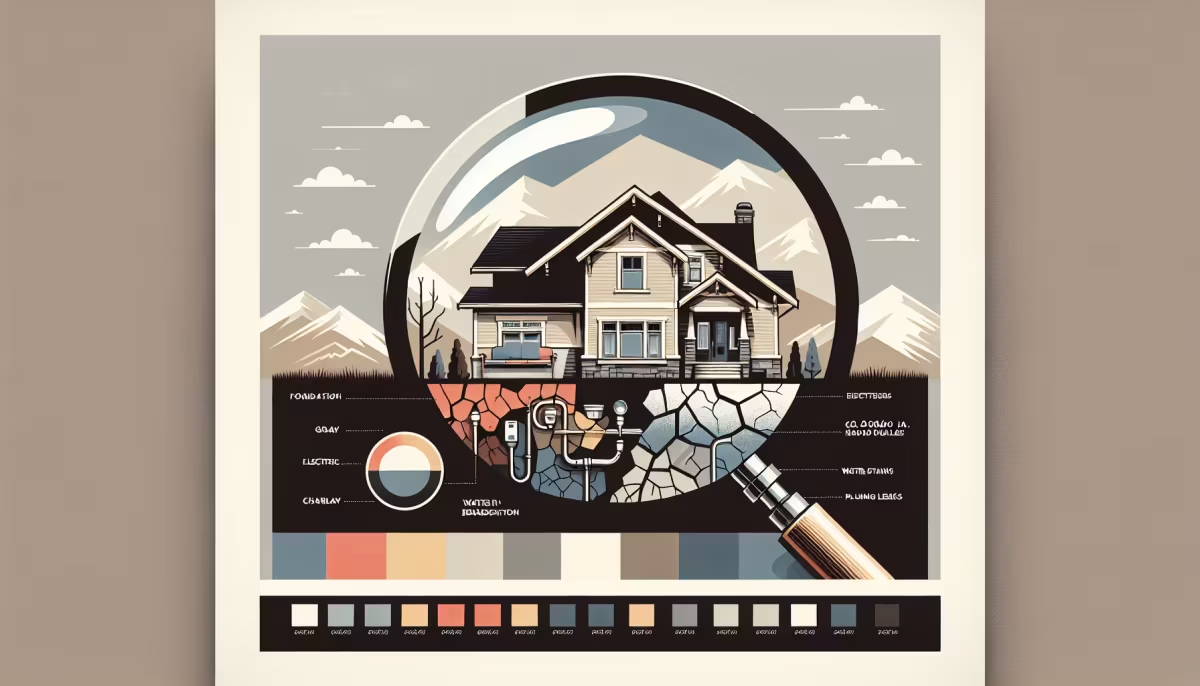
In Colorado, the construction-defect cases I see fall into four broad categories. The categories are useful not because the law treats them identically — it does not — but because the diagnostic patterns, the responsible trades, and the realistic remedies vary substantially across them. A homeowner who can identify which category their problem belongs to is a homeowner who can ask better questions of the inspector, the builder, and the lawyer.
Here is how the categories break down, with the patterns I see most often in each.
Category one: Structural defects
Structural defects are the smallest category by volume and the largest by individual case value. They involve the load-bearing systems of the house — the foundation, the framing, the roof structure, and the connections between them — and they fail in ways that are expensive to remediate even when caught early.
The most common Front Range patterns:
Foundation movement beyond engineered tolerance, often associated with Colorado's expansive bentonite soils, manifesting as horizontal basement-wall cracks, separated slab joints, or floor heave
Inadequate footings or improperly compacted fill under foundations, particularly in cut-and-fill hillside lots
Undersized or improperly fastened roof framing — wrong rafter sizes, missing collar ties, missing hurricane clips at the wall plate connection
Wall framing with stud bays out of plumb, missing or improperly placed headers above windows, or shear walls with missing or improperly nailed sheathing
Deck and balcony attachment failures — ledger boards lag-screwed into rim joists without through-bolts or proper flashing
The remediation for a structural defect almost always involves opening finishes, exposing the structure, and rebuilding to spec. The disruption is significant; the cost is significant; and the homeowner can rarely live in normal occupancy during the repair. This category is the one where prompt notice and a careful CDARA Notice of Claim sequence pays the largest dividends, because the cost of remediation is almost always recoverable when the defect is documented properly.
Category two: Water-intrusion and moisture defects
Water intrusion is the largest category of construction-defect cases I handle by volume, and arguably the most important because of how the damage compounds. A small water-intrusion defect produces a large mold, rot, and structural problem if left untreated.
The patterns are remarkably consistent:
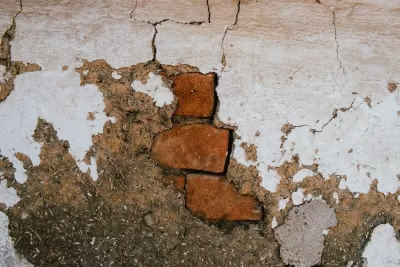
Stucco and EIFS failures — improperly terminated edges, missing weep screeds, inadequate sealant at penetrations, no drainage plane behind the cladding
Window installation defects — missing or improperly lapped flashings, sealant used as a substitute for proper integration with the weather-resistive barrier, sills without back-dams
Roof-to-wall flashing failures — missing kick-out flashings at the end of roof-to-wall intersections, step flashings shingled in the wrong sequence
Deck-ledger detailing failures — ledgers attached without flashing, water-managed surfaces draining toward the house instead of away
Below-grade waterproofing failures — missing or damaged dampproofing on foundation walls, no drainage layer, perimeter drains routed into the daylight when they should run to sumps
Improper exterior grade — soil sloped toward the house, or hard surfaces (patios, sidewalks) installed at or above sill plate elevation
A useful general rule: water-intrusion defects almost always involve a system failure, not a single product failure. The shingles did not "fail"; the flashing detail at the chimney was wrong, and the shingles cannot compensate. Identifying the system failure is what distinguishes a defect inspection from a maintenance inspection.
For the diagnostic walk-through, see our companion piece on how to spot construction defects in your home.
Category three: Mechanical, electrical, and plumbing (MEP) defects
MEP defects are the category most likely to be missed at original inspection and most likely to be normalized by homeowners over time. They tend to show up as nagging problems rather than dramatic failures.
Common patterns:
HVAC sizing and distribution defects — undersized return air, oversized cooling capacity, ducts in unconditioned attics without proper insulation, supply registers installed without proper transitions
Plumbing pressure and venting issues — pipes inadequately strapped, no air chambers at washing-machine and dishwasher connections, drain lines with improper slope, vent stacks terminating too close to operable windows
Electrical panel and branch-circuit defects — double-tapped breakers, shared neutrals between non-multi-wire branch circuits, aluminum branch wiring at devices not rated for it, missing arc-fault protection where code required it
Slab leaks in homes with post-tension or hydronic systems where the tubing was nicked or improperly routed
Gas-line defects — flexible connectors used inappropriately, joints not properly tested, regulators sized incorrectly
The legal challenge with MEP defects is that they accumulate as a pattern more often than they present as a single dramatic failure. A defect-inspection report on an MEP-heavy case may identify thirty individual items across the house, none of which alone would be litigation-worthy, but which together represent a builder-systemic failure that supports a substantial claim.
Category four: Finish, fit-and-finish, and code-compliance defects
The fourth category covers everything else — the visible, surface-level defects that homeowners notice first and that lawyers often take least seriously. Improperly cut tile, drywall corners that telegraph through paint, exterior trim with visible gaps, door and window hardware misaligned, hardwood floors with excessive seasonal movement.
By themselves, fit-and-finish defects rarely support significant legal claims. They are, however, often the symptom that points to a deeper problem:
Drywall cracking in a pattern that suggests structural movement
Tile failures that reveal the substrate was prepared improperly
Window seal failures that indicate improper installation rather than product defect
Hardwood movement that reflects an underlying moisture problem
The right approach to fit-and-finish defects is to investigate one level deeper before dismissing them. The defect a homeowner can see is often the only visible symptom of the defect the homeowner cannot see.
How the categories interact with the legal claim
Colorado's Construction Defect Action Reform Act treats all four categories under a common framework. The Notice of Claim must describe the defects with specificity; the builder has the opportunity to respond, inspect, and offer repair or settlement; and the dispute proceeds from there.
What varies across categories is the damages model and the realistic recovery:
Structural defects — usually the highest recoverable damages, often including alternative housing during remediation, and frequently triggering insurance coverage from the builder's CGL policy
Water-intrusion defects — frequently the largest case in aggregate, because the damage continues to compound until the breach is fixed
MEP defects — usually documented as a pattern with cumulative damages, sometimes including damages for prior repairs the homeowner already paid for
Fit-and-finish defects — recoverable on their own face value, but more important as evidence of deeper problems
For the broader dispute-path overview, see the Colorado construction defect dispute resolution guide.
What to do if you suspect any of these
The advice does not vary much by category:
Document what you can see, with dated photographs and a written narrative.
Gather your closing documents — warranty, punch list, builder correspondence.
Avoid contacting the builder informally before you have evidence assembled and counsel engaged.
Engage an independent defect inspector familiar with construction-defect work — not the original transaction inspector. See what happens during a construction defect inspection.
Consult a construction-defect attorney before sending any notices, because the CDARA notice procedure has specific timing requirements and informal builder communications can compromise the legal posture.
The defects do not improve on their own. The legal posture, however, can improve substantially with the right early steps — and can get materially worse without them.
Have Questions About Construction Defects?
Our experienced construction defect attorneys are here to help. Schedule a free 15-minute screening call to discuss your situation.