
Contract Review & Project Planning

A construction contract is one of the most important documents a homeowner will sign. Whether it is a builder-provided form for a new home, a major remodel agreement, or a series of subcontractor agreements stitched together by a general contractor, the words on the page determine what you have a right to expect — and what recourse you have if things go wrong.
We work with Colorado homeowners both before they sign and after a dispute has arisen. The goal up front is the same as the goal in litigation: align the contract with what was actually promised, anticipate the failure points, and put the homeowner in the strongest practical position under Colorado law.
Contract Drafting and Review
A well-drafted residential construction contract should address, at minimum, the scope of work, the schedule and price structure, payment and change-order procedures, warranty and indemnification terms, insurance and licensing requirements, lien-waiver protocols, and a dispute-resolution mechanism that complies with Colorado law.
We review builder-provided contracts and bespoke agreements and flag terms that meaningfully shift risk onto the homeowner. For background on the provisions that matter most, see our guide to the essential terms in Colorado construction contracts and our homeowner-focused overview of understanding construction contracts.
Contract Negotiation
Construction contracts are negotiable far more often than homeowners assume. Builders use standard forms because they are efficient, not because every clause is non-negotiable. We help homeowners propose targeted edits — to scope, payment timing, change-order procedures, dispute resolution, and limitation-of-damages clauses — that preserve the project's economics while removing the most lopsided risk allocations. See our guide to negotiating favorable terms in your construction contract for the most common starting points.
Contract Disputes
Even careful planning cannot eliminate every dispute. The most common ones we see involve:
Construction Delays
Project delays have real financial consequences — carrying costs, lost use of the home, and (sometimes) liquidated damages. Whether the delay is excusable depends on the contract, the cause, and how the parties documented the work along the way.
Construction Defects
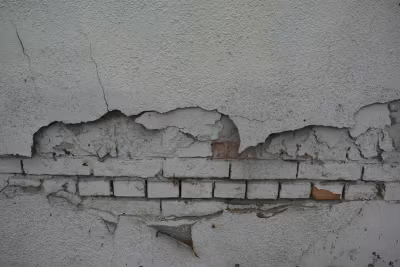
Defects in workmanship or materials can compromise the safety, value, and habitability of a home. Catching them early matters — our article on how to identify signs of construction defects in your home covers the most common indicators. Defect claims also trigger the CDARA pre-suit Notice of Claim process, described below.
Payment Disputes
Disagreements over payment — unpaid invoices, withheld retainage, charges for unauthorized work — are among the most common contract disputes. Homeowners evaluating whether to withhold payment should first understand when a homeowner can withhold payment for faulty workmanship, because acting too aggressively can create new exposure.
Mechanic's Liens
Unpaid contractors and subcontractors may record mechanic's liens against the property. Colorado's lien statutes impose strict procedural and timing requirements that frequently render recorded liens defective. For a homeowner-focused overview, see our Colorado mechanic's lien guide for homeowners.
Colorado Law Governing Residential Construction Contracts
Even a well-drafted contract does not exist in a vacuum. Colorado law supplies a layer of protections — and procedural requirements — that override or supplement what the parties wrote down. Understanding that backdrop is essential for negotiating up front and for evaluating a dispute after the fact.
Implied Warranties for New Residential Construction
Colorado has long recognized that builders of new homes give the buyer implied warranties of habitability and workmanlike construction. The Colorado Supreme Court established this rule in Carpenter v. Donohoe, 388 P.2d 399 (Colo. 1964), holding that builder-vendors of newly constructed homes impliedly warrant that the home was built in a workmanlike manner and is suitable for habitation. These implied warranties exist independent of the written contract, and Colorado courts are skeptical of attempts to disclaim them through boilerplate language.
CDARA: The Pre-Suit Notice of Claim Process
When a homeowner asserts a construction defect claim against a construction professional, the Construction Defect Action Reform Act (CDARA, C.R.S. § 13-20-801 et seq.) requires a specific pre-suit Notice of Claim procedure before suit can be filed. The notice triggers an inspection window and an opportunity for the builder to propose repairs or a monetary settlement. These statutory requirements apply regardless of how the contract characterizes the relationship, so contract drafting and dispute strategy both have to account for CDARA from day one.
Time Limits That Cannot Be Contracted Away
Construction-defect and breach-of-contract claims in Colorado are subject to layered time limits — a discovery-based statute of limitations and an outer statute of repose that runs from substantial completion. The specific deadlines vary by claim type, but the key point for contract review is that no contract clause can extend a homeowner's exposure indefinitely or quietly shorten the homeowner's window to sue without that change being clearly disclosed. We routinely flag indemnity, tolling, and notice provisions that interact awkwardly with these statutory deadlines.
Key Clauses Every Colorado Construction Contract Should Address
Most construction disputes we see trace back to two or three contract clauses that were missing, ambiguous, or one-sided. Whether you are reviewing a builder-provided form or drafting a custom agreement, the following provisions deserve close attention before signing.
Scope of Work and Specifications
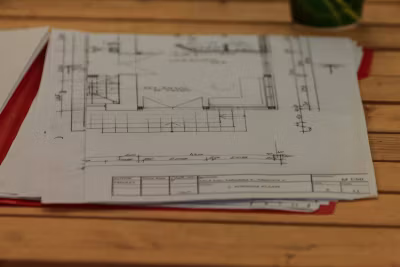
The scope provision should incorporate the architectural plans, specifications, allowances, and any model-home or marketing representations the homeowner relied on. Vague phrases like "industry standard" or "as agreed" create disputes; line-itemed scopes with referenced drawings prevent them.
Change Orders and Cost Overruns
Every change-order clause should require a written, signed authorization before extra work begins, identify how unit prices and overhead are calculated, and tie schedule adjustments to specific change events. Open-ended "time and materials" or "to be determined" pricing is a leading source of payment fights at the end of a project.
Payment Schedule, Retainage, and Lien Waivers
A clean draw schedule ties each payment to defined, verifiable progress milestones. Reasonable retainage holdback protects the homeowner until punch-list items are complete. And lien-waiver language has to match the payments actually made — overbroad waivers can extinguish rights the homeowner did not intend to release.
Indemnification, Insurance, and Limitation-of-Damages Clauses
Many builder-drafted contracts shift risk onto the homeowner through one-sided indemnity provisions, narrow insurance requirements, or caps on the builder's liability. These clauses are not automatically enforceable in Colorado, but they are far easier to negotiate before signing than to litigate later. Pay particular attention to consequential-damages waivers and any limitation of liability tied to the contract price.
Right to Cure and Notice Provisions
Independent of CDARA, many contracts include their own notice and cure provisions that condition the homeowner's remedies on giving the builder a chance to fix problems first. These clauses need to be internally consistent and harmonized with CDARA so that complying with one set of requirements does not inadvertently waive rights under the other.
Dispute Resolution: Arbitration vs. Litigation
Builder contracts frequently include mandatory arbitration clauses, sometimes paired with class-action waivers, choice-of-venue provisions, or fee-shifting language. Arbitration is not inherently bad, but the specific forum, rules, cost allocation, and discovery limits matter a great deal. Our guide to Colorado construction arbitration clauses walks through how those provisions tend to play out in practice.
When a Contract Dispute Has Already Arisen
If a dispute is already underway, the first 30 to 60 days are usually the most consequential. Preserve every email, text, and project photograph. Document on-site conditions before any repairs are made. Do not sign change orders, lien waivers, or settlement agreements under pressure. And do not stop performing under the contract — or pay disputed invoices in full — without first understanding how those actions affect your legal position.
Early counsel matters because Colorado's construction-related deadlines are unforgiving. Statutes of limitations and repose, CDARA notice windows, contractual notice-and-cure periods, and mechanic's-lien deadlines can all run in parallel, and missing any one of them can narrow or eliminate available remedies. A short, focused consultation early in a dispute often saves substantial cost down the road.
How We Handle Contract Matters
In practice, our work on these matters typically includes:
A clause-by-clause review of the proposed or executed contract against Colorado law and the homeowner's actual expectations.
Targeted redline proposals for builder-form contracts before signing, focused on the provisions most likely to matter in a dispute.
Where a dispute has already arisen, an early review of the contract, the paper trail, on-site conditions, and the applicable statutory deadlines.
Coordinated handling of CDARA notice obligations, contractual notice-and-cure provisions, and any mechanic's-lien exposure on parallel tracks.
Negotiation, mediation, arbitration, or litigation through to resolution — chosen based on the contract, the facts, and the homeowner's goals.
For homeowners earlier in the process, our articles on common mistakes when signing construction contracts and the importance of clear language in construction contracts are both worth reading before signing anything.
Talk With Us
If you are negotiating a new construction contract, reviewing a builder-provided form, or trying to figure out where you stand on a project that has already gone sideways, we can help. Consultations are free, confidential, and carry no obligation. Call us at (303) 276-2647 or schedule a consultation online.

Have Questions About Your Case?
Schedule a free 15-minute screening call to discuss your construction defect or property damage claim with our experienced attorneys.