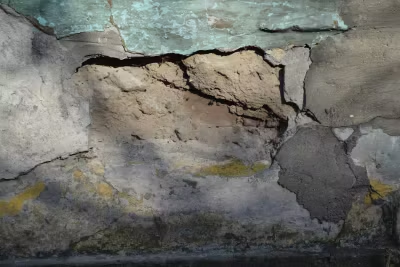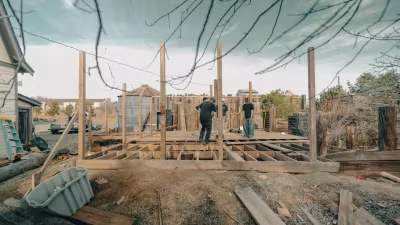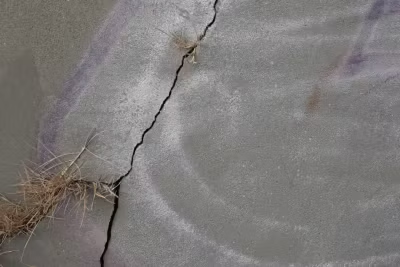
Most calls about defects in a KB Home — or in any large production-builder community in Colorado — start with a single house. A homeowner sees water staining at a window head. Or notices the back patio has separated half an inch from the wall. Or watches an interior crack reopen after the builder's crew finished its repair. The instinct is to think of the problem as something between this homeowner and this builder.
In a production community, that framing is sometimes right and sometimes incomplete. The question I learn to ask early is whether the symptom in the caller's house is showing up in the neighbors' houses too. The answer changes the legal options materially. I want to walk through that question — and a handful of related questions specific to production-builder communities — without saying anything about KB Home's conduct in any particular project. The framework below applies to KB Home, to every other national production builder, and to the Colorado regional builders.
By way of disclosure: I represent homeowners. I do not represent builders. I am writing this for a homeowner audience and treating the question of whether a defect exists in a given home as something only an inspection can answer.
Why the "individual or community" question matters first
Production builders use repeating designs. The same wall assembly, the same roof-to-wall flashing detail, the same foundation specification, the same window installation method get used across dozens or hundreds of homes in a single community. When a design or installation choice is the underlying cause of a defect, the defect tends to manifest in many homes, not one — sometimes immediately, sometimes after years of weather cycling.
That has two consequences for legal strategy:
On the homeowner's side, a community-wide pattern usually expands the leverage. A builder evaluating a single complaint can treat it as an isolated case; a builder evaluating fifty complaints in the same subdivision is looking at a different problem.
On the procedural side, Colorado's HOA construction-defect rules become relevant. The Colorado Common Interest Ownership Act and CDARA together govern when and how an HOA may pursue defect claims on behalf of the community, particularly for defects in common elements or in repeating components across multiple units. The association's standing, the procedural requirements before suit, and the homeowner-vote requirements have all been the subject of legislative attention and continue to be technical.
For an individual homeowner the practical question is: do I open my own file, or do I raise the issue with the HOA board first, or both?
There is no one answer. If the defect is contained to a single house — a missed inspection on this lot, a one-off subcontractor error — the individual track is the right one. If it appears in many houses or in common elements, the association track is usually more efficient. Some homeowners pursue both, with the individual file covering uniquely individual damages and the association file covering shared work. The right choice turns on what an inspection shows about which homes are affected.
Arbitration clauses and forum selection
The second feature of production-builder transactions worth understanding early is the contractual dispute-resolution forum.
A substantial share of production-builder purchase agreements direct construction-defect disputes to private arbitration rather than to court. Colorado courts generally enforce such clauses where they meet the contract-formation standards, though there are doctrines under which a clause can be challenged. The choice of forum affects the cost, the timeline, the discovery available, the public visibility of the dispute, and the available remedies. It is one of the first features I look at in any new file.
Reviewing this is not a five-minute task. Production-builder forms vary across regions, model years, and community phases; the version in one neighbor's binder may not be the version in another's. I would not assume what is in your contract until you have actually read it.
Limitations: the procedural traps
Colorado construction-defect claims are bounded by two clocks running at the same time.
The statute of limitations at C.R.S. § 13-80-104 generally allows two years from when the claim accrues, with accrual tied to when the physical manifestation of a defect was or reasonably should have been discovered. The statute of repose sets an outer boundary measured from substantial completion of the improvement, beyond which most claims cannot proceed regardless of when discovery occurred.
Layered on top of those is CDARA's notice procedure at C.R.S. § 13-20-803.5, which requires a written notice of claim to the builder, a defined inspection period, and an opportunity for the builder to offer repair or settlement before suit (or arbitration) may be initiated. The procedure interacts with the running of the limitations clock in ways that are not always intuitive — and missing the interaction is the single most common procedural mistake I see in otherwise meritorious homeowner cases.
Two practical observations:
The CDARA notice itself is not the lawsuit. It does not, by being sent, preserve every right indefinitely.
A homeowner who has been "waiting to see if the repair holds" for two years has, in some configurations, allowed the limitations clock to run while believing they were being patient.
If you are a few years post-closing and only now seeing symptoms, the timing analysis is the first conversation to have, not the last.
What an inspection actually looks at in a production community
A construction-defect inspection in a production-builder home is not just a walk-through. Done well, it looks at:
The as-built versus the original plans and specifications, where those are available.
The construction details at common failure points — window head and sill flashing, roof-to-wall intersections, deck ledger connections, slab-to-wall waterproofing, foundation drainage paths.
The soils report and the foundation design relative to the actual soils on the lot — particularly important in expansive-soil regions of the Front Range.
Moisture readings in wall assemblies where staining or odors suggest a hidden problem.
The repair history. Prior builder repair attempts often tell more about the underlying defect than the symptom itself does, because they reveal which theory of the case the builder was working from.
This is qualitatively different from the home inspection done before closing, which is typically a visual exam focused on safety items and maintenance. A defect inspection is a forensic exercise, and competent ones are not cheap. The cost is one reason the individual-versus-community framing matters: the per-home cost of a thorough defect inspection drops substantially when several neighbors share the inspector and the scope.
The implied warranty layer
Colorado recognizes an implied warranty of habitability running from a builder-vendor to a first purchaser, applicable to defects that materially affect a home's fitness for residential use. The warranty operates alongside the express limited warranty in the closing binder and is not always disclaimed away by the contractual paperwork, depending on how the documents are written and the facts of the dispute.
In production-builder cases this matters because express warranties tend to be narrowly drafted. The implied warranty can occasionally reach defects the contractual warranty does not, particularly structural defects discovered within the broader limitations window. Whether it applies in any specific case is fact-specific.
What to do this week if you suspect a defect
Three concrete steps, in order:
Compare notes with your neighbors. Not to start a campaign — to gather information. If three neighbors in a row have stucco cracks at the same elevation, or repeated water at the same window orientation, that pattern is information a single homeowner cannot generate alone.
Find your purchase contract, your warranty book, and any prior builder correspondence. Read what the contract says about dispute resolution and what the warranty says about notice. If the documents are not in one place, getting them in one place is itself the first step.
Avoid signing anything new from the builder until the documents are reviewed. Repair authorizations, releases, and warranty addenda all have language that can affect later options. They are not always problematic, but they are not always neutral either.
A short consultation is the right next step after those three. The call can usually answer the high-level questions — is this likely to be an individual or community matter, does the timing work, is your contract in court or in arbitration — and produce a plan for whether further inspection is warranted. There is no charge for that initial conversation.
Have Questions About Construction Defects?
Our experienced construction defect attorneys are here to help. Schedule a free 15-minute screening call to discuss your situation.