
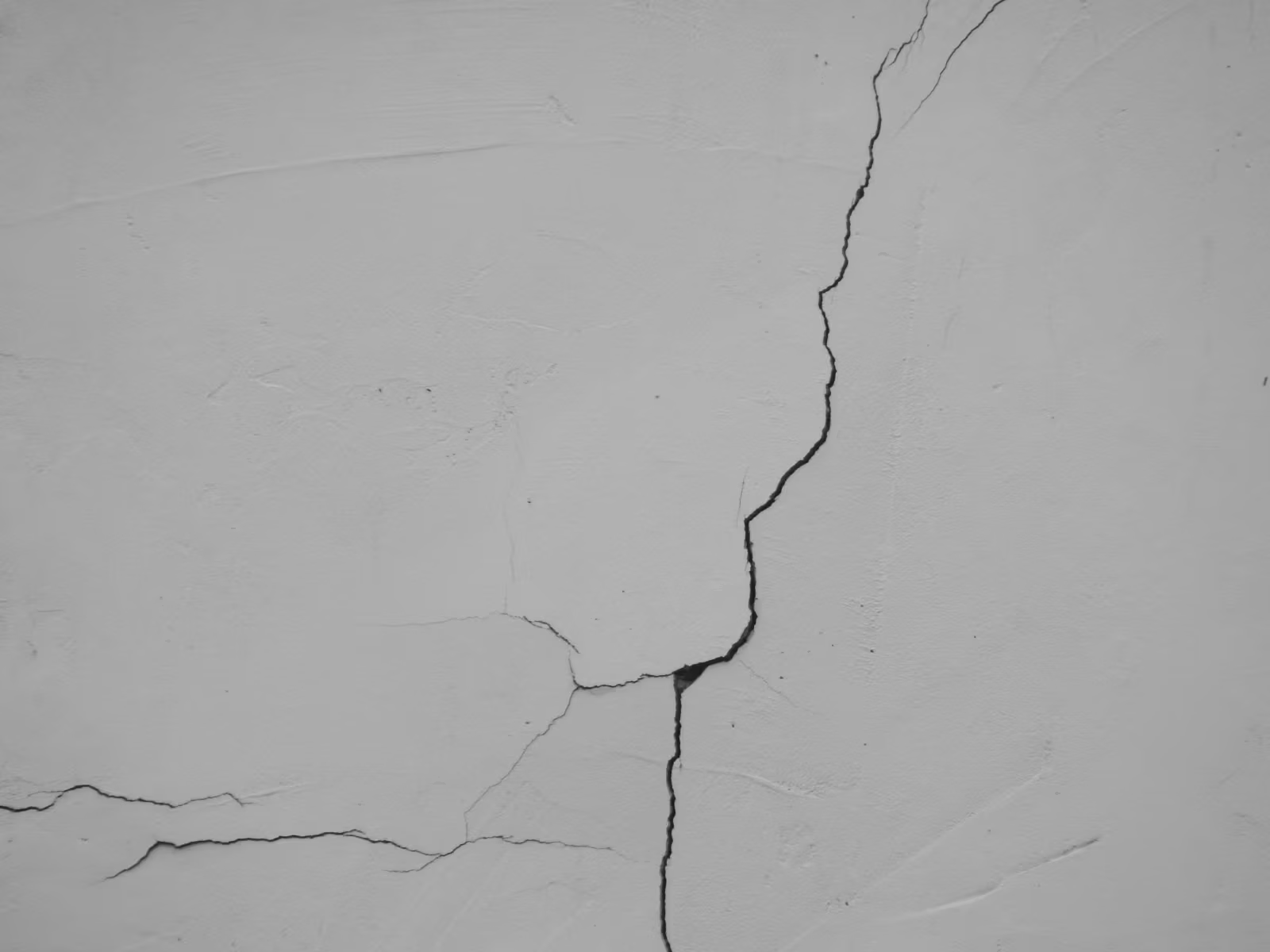
Colorado homeowners pour their savings, their credit, and their future into the house they buy. When that house turns out to be defectively built — a cracking foundation, a leaking envelope, an HVAC system that never worked right — the financial and emotional cost is enormous. Worse, the legal path to recovery is narrow, technical, and full of deadlines that quietly run out while homeowners try to figure out what to do.
That is the work of Hollington Law Firm. We are a Colorado law firm that represents homeowners and HOAs — never builders — in construction defect, construction contract, and related real estate disputes. Attorney W. Neal Hollington has spent more than eight years in this practice area, handling cases against the major national builders and regional contractors working throughout Colorado, and has secured multiple six-figure settlements and resolutions for homeowner clients. If you are dealing with a defective home, this page is the starting point for understanding what your rights actually are under Colorado law and what to do next.
What Counts as a Construction Defect Under Colorado Law
A "construction defect" in Colorado is not just shoddy work. It is a legal term defined by the Construction Defect Action Reform Act ("CDARA"), Colorado Revised Statutes § 13-20-801 et seq. To bring a claim, the defect must give rise to one of several recognized legal theories — most commonly negligence in construction, breach of express or implied warranty, breach of the construction contract, or a violation of the Colorado Consumer Protection Act.
Defects fall into two categories. Patent defects are visible on reasonable inspection — a cracked foundation, a sagging roofline, an obviously leaking window. Latent defects are hidden and reveal themselves only after time, water exposure, or seasonal soil movement. Most of the cases we litigate involve latent defects that emerge two to six years after closing, often after the developer's express one-year or two-year warranty has expired.
What every viable Colorado construction defect claim has in common is causation: the defect must be traced to a specific failure of design, workmanship, materials, or supervision by an identifiable party — the builder, a subcontractor, the design professional, or the developer. That causation analysis is where construction defect litigation either succeeds or falls apart, and it is why these cases are expert-driven from the first inspection forward.
The Most Common Construction Defects in Colorado Homes
The defects we see in Colorado tend to cluster around the conditions unique to Front Range and mountain construction:
Expansive soils and foundation movement. Bentonite-rich clays across the Front Range swell when wet and shrink when dry, generating uplift pressure that cracks slabs, racks doorframes, and tears drywall. Inadequate soil engineering, missing void spaces under structural slabs, and improperly designed post-tension foundations are leading causes.
Stucco, EIFS, and siding water intrusion. Improper flashing, missing kickout diverters, and unsealed penetrations let water into wall cavities, where it rots sheathing and grows mold. By the time a homeowner sees a stain, the structural damage is years old.
Roofing, deck, and balcony failures. Wind-zone underperformance, defective installation of underlayment, missing ice-and-water shield, and improperly waterproofed deck-to-wall transitions are routine claims in Colorado.
HVAC and mechanical defects. Undersized systems, improper duct sealing, condensate-line failures, and refrigerant-charge errors lead to comfort complaints, premature equipment failure, and moisture problems.
Electrical and plumbing defects. Aluminum-to-copper transitions, undersized panels, PEX line failures, and venting violations create both safety and code-compliance issues.
Code violations and unpermitted work. Work that was never permitted, never inspected, or quietly closed out without sign-off can give rise to separate claims under the Colorado Consumer Protection Act in addition to CDARA.
Each of these categories has its own evidentiary requirements, expert disciplines, and damages framework. The strongest cases combine multiple categories — a foundation problem that caused stucco cracks that allowed water in that fed mold growth — and the value of those cases depends on how each layer is documented and proved. For a deeper look at foundation movement — Colorado's signature defect — see our article Colorado Foundation Problems: Types, Causes, and Legal Rights.
Deadlines: Colorado's Statute of Repose and Statute of Limitations
The single most important issue in any Colorado construction defect matter is timing. Colorado has both a statute of limitations and a statute of repose, and missing either one ends the case regardless of how serious the defect is.
The two-year statute of limitations runs from the date the defect, or its physical manifestation, was discovered or should have been discovered through reasonable diligence (CRS § 13-80-104(1)(a)). The clock does not start when the house was built; it starts when the homeowner knew, or should have known, that something was wrong. That "manifestation" rule is intensely fact-specific and is often the central battleground in motions filed by the builder.
The six-year statute of repose is an outer limit. Under CRS § 13-80-104(1)(a), no construction defect claim may be brought more than six years after substantial completion of the improvement to real property — with one important exception. If the defect's physical manifestation occurs in the fifth or sixth year, the homeowner has two additional years from manifestation to file, but not beyond eight years total from substantial completion.
The practical consequence is that Colorado homeowners who notice a problem need to get a legal opinion quickly. Many defects manifest seasonally, get attributed to "settling," and are quietly tolerated for a year or two before the homeowner consults a lawyer — by which point a winnable case has become a time-barred one. If you are seeing signs of a defect in a home that is anywhere between three and eight years old, that is the call to make today. For a more detailed walk-through of how Colorado courts apply the manifestation rule, see Understanding Statutes of Limitations for Construction Defect Claims.
The CDARA Notice of Claim Process
A Colorado homeowner cannot simply file a construction defect lawsuit. Before any litigation, CDARA requires a formal Notice of Claim delivered to the builder and any other potentially responsible party (CRS § 13-20-803.5).
The Notice of Claim must describe the alleged defects in detail sufficient to permit the builder to investigate. From the day the builder receives it, a 75-day clock begins (90 days for commercial properties). Within that window the builder may inspect the property, request additional information, and either offer to repair, offer monetary settlement, or do nothing. The statute of limitations is tolled during this notice period, which is one of the few procedural advantages built into the framework.
In our experience the builder's initial response is rarely adequate. Common patterns we see include token repair offers that address surface symptoms rather than the underlying defect, settlement offers calculated against the builder's repair cost rather than the homeowner's actual cost of remediation, and inspections conducted by the builder's own employees with no independent engineering input. The Notice of Claim phase is also where the builder begins building its defenses — which is why having engineering and legal representation in place before the notice is served, rather than after, materially changes the outcome.
If the response is inadequate or refused, the homeowner is then free to file suit (or, if the contract requires it, to demand arbitration). The Notice of Claim itself often shapes what relief is available later: a poorly drafted notice can be used by the builder months later to argue that specific defects were not preserved. When a builder stonewalls or ignores the Notice of Claim, the homeowner's procedural options are narrow — see What If the Builder Doesn’t Respond to a CDARA Notice.
Damages Available Under Colorado Construction Defect Law
CDARA limits and channels the damages a homeowner can recover, and understanding the framework before filing is critical to valuation:
Cost of repair. The primary measure in most Colorado construction defect cases. Repair cost is established by qualified engineering and construction experts and must reflect the cost to bring the home into the condition it was warranted to be in — not merely to patch symptoms.
Diminution in value. Where repair is impossible or impractical, or where stigma has impaired the property's market value even after repair, diminution in value may be recovered. This requires real-estate-appraisal expert testimony.
Temporary housing and relocation. Reasonable costs of relocating during invasive repairs are recoverable.
Personal property damage. Damage to flooring, finishes, electronics, furniture, and stored items caused by the defect (typically by water intrusion) is recoverable.
Attorneys' fees and costs. Available in specific circumstances — under the Colorado Consumer Protection Act for CCPA-based claims, under contractual fee-shifting clauses, and under CDARA's offer-of-settlement provisions when an offer is rejected and the homeowner does not improve on it at trial.
Statutory limitations. Noneconomic damages are capped under CRS § 13-20-806 in actions against builders, and the statute restricts certain categories of damages that are otherwise available in tort.
The valuation of a construction defect case is almost never obvious from the outside. A foundation problem that looks like a $40,000 repair to a homeowner can resolve for low six figures once full remediation cost, diminution in value, and relocation are properly proved — or it can resolve for less, depending on how the defect is documented and what concessions have already been made. This is one of the areas where having counsel before the Notice of Claim materially affects outcome. For a structured guide to what is and is not recoverable, see Colorado Construction Defect Damages: A Legal Guide.
How Builders Defend These Cases — And How We Counter
Construction defect litigation is well-funded on the defense side. The largest national builders and their insurers have litigation playbooks, preferred experts, and standard tactics. The most common defenses we see, and how we approach them:
"It is a maintenance issue, not a defect." The builder will often blame the homeowner — missed sealant maintenance, improper landscaping, gutter neglect. We counter with engineering expert reports that distinguish original-construction failure from in-service degradation, and with manufacturer documentation that shows the alleged maintenance was either unnecessary, undisclosed, or impossible under the design as built.
"The homeowner didn't follow the owner's manual." Builders increasingly include detailed maintenance manuals that purport to shift responsibility to the homeowner. We address these with arguments about adequacy of disclosure, conflict with implied warranties, and CDARA's prohibition on contractual provisions that nullify the act's protections.
"The damages are speculative." Builders attack repair-cost methodology aggressively, particularly the scope of remediation and the qualifications of the homeowner's experts. We address this with detailed scope-of-work documentation, independent unit-cost validation, and well-supported expert disclosures.
"The arbitration clause controls." Most builder contracts in Colorado include mandatory arbitration clauses. We evaluate these clauses against Colorado law on unconscionability, the Federal Arbitration Act, and (where applicable) the protections added under Colorado Senate Bill 24-106 (2024), which constrained certain forced-arbitration provisions in residential real estate.
"The warranty does not cover this." Express warranty exclusions are typically narrow when read carefully, and the implied warranties of habitability and merchantability — recognized in Colorado real estate law — survive most contractual disclaimers.
"You waited too long." As discussed above, the limitations and repose defenses turn on when "manifestation" occurred. The factual record built during the Notice of Claim phase often controls how this argument plays out two years later.
Each defense has an answer. The cases that succeed are the ones where the answer was prepared from the beginning — before the Notice of Claim, before the first inspection, before any concession was put in writing. The arbitration-clause defense in particular is its own analysis — we cover Colorado's framework in Colorado Construction Arbitration Clauses Guide.
How Hollington Law Firm Approaches Your Case
Every construction defect matter we take begins the same way. We sit down with the homeowner — at no charge — and review what they have: closing documents, the express warranty, photographs, repair estimates, communications with the builder, and any prior inspections. From that initial review we form a working theory of the case and identify what additional evidence we need.
If the matter warrants it, we engage qualified engineering experts to inspect the property. Construction defect cases are won and lost on expert evidence, and the engineer or building scientist we bring in at the front end is usually the same expert who will testify at trial or arbitration. That continuity matters.
From there the work falls into three phases: pre-suit (Notice of Claim, negotiation, and where possible early resolution), litigation or arbitration if pre-suit fails, and trial preparation. We handle cases on contingency, hourly, and hybrid fee structures, depending on the strength of the claim, the resources of the defendant, and what makes economic sense for the client. Many homeowner cases proceed on contingency, so that no fees are paid unless we recover.
We represent homeowners and HOAs exclusively in these matters. We do not defend builders, contractors, or insurers in construction defect cases, and that focus is intentional — it sharpens our perspective, keeps us out of conflicts, and means our institutional knowledge of how builders defend these cases is built from one side of the courtroom only. For HOAs evaluating a community-wide defect claim, see HOA Construction Defect Lawsuits: Your Community’s Rights.
About W. Neal Hollington
W. Neal Hollington has practiced Colorado construction defect and real estate litigation for more than eight years and has been recognized as a Best Lawyers "Ones to Watch" in Construction Litigation and as a Super Lawyers Rising Star. He has secured multiple six-figure settlements and resolutions for Colorado homeowner clients. Our practice handles construction defect matters against all of the major national builders operating in Colorado — including DR Horton, Lennar, Pulte, Taylor Morrison, Tri Pointe, and Meritage — as well as regional and custom builders working throughout the state.
His practice focuses exclusively on representing homeowners and homeowner associations in construction defect, mechanics' lien, construction contract, and related real estate disputes. He has handled matters statewide, with concentrations in the Denver metro, Colorado Springs, Boulder County, and the northern Front Range.
Frequently Asked Questions
How much does it cost to sue a builder in Colorado? It depends on the fee arrangement. We handle many homeowner construction defect cases on contingency, meaning no attorneys' fees are paid unless we recover. Engineering experts, deposition costs, and filing fees are separate. We discuss fee structure at the initial consultation, before any retainer is signed.
How long does a construction defect case take? The Notice of Claim process alone is at least 75 days. If the matter resolves in negotiation after the NOC, it can conclude in three to nine months. Cases that proceed to litigation or arbitration typically resolve in twelve to twenty-four months, depending on complexity and the defendant.
Can I sue if I bought the house from someone else? Yes. Construction defect claims under CDARA generally run with the property for the limitations and repose periods — meaning a second or third owner can bring claims against the original builder, subject to the same deadlines. Disclosure claims against the seller are separate and analyzed independently.
What if my contract requires arbitration? Most modern builder contracts in Colorado include arbitration clauses. Whether the clause is enforceable depends on its specific terms, the contract formation circumstances, and applicable Colorado and federal law. We evaluate the clause as part of the initial review.
Do I have to give the builder a chance to repair before suing? Yes. CDARA's Notice of Claim process is mandatory. You cannot skip it. Failing to comply with the NOC requirements can result in dismissal of the lawsuit. The notice phase is also tactically important — what is preserved or not preserved during it shapes the case.
What if the builder is out of business? Many builders operate through single-purpose entities that dissolve after project completion. We routinely pursue claims against parent companies, successor entities, individual licensees, design professionals, and subcontractors. Builder bankruptcy adds procedural complexity but rarely ends a case. For the bankruptcy-specific path, see What Happens When a Builder Files Bankruptcy.
Are construction defect settlement proceeds taxable? Generally, recoveries that restore the value of damaged property are not taxable income — they are a return of capital. Recoveries categorized as punitive damages or interest are taxable. We coordinate with the homeowner's tax advisor when settlement structure matters. See Are settlement proceeds taxable for more.
Talk to a Colorado Construction Defect Lawyer
If you are seeing signs of a construction defect in your Colorado home — cracking foundations, water intrusion, failing siding, mechanical or electrical problems, or unpermitted work — the most valuable thing you can do is get a legal opinion before deadlines run. The initial consultation is free and confidential.
When you contact us, bring (or be ready to send) your closing documents, the builder's express warranty, photographs of the conditions you are concerned about, any repair estimates or engineering reports you have obtained, and your communications with the builder. We will review the matter, give you our honest assessment of the merits and timing, and explain what your options actually are.
Schedule a consultation or contact our office to get started. We represent homeowners and HOAs statewide in Colorado construction defect matters.