When a Colorado homeowner discovers a serious construction defect, the legal question is rarely whether something is wrong. Cracked foundations, leaking windows, framing out of square, and roofs that fail early all speak for themselves. The harder question is how you fight it — and that choice can matter as much as the underlying claim.
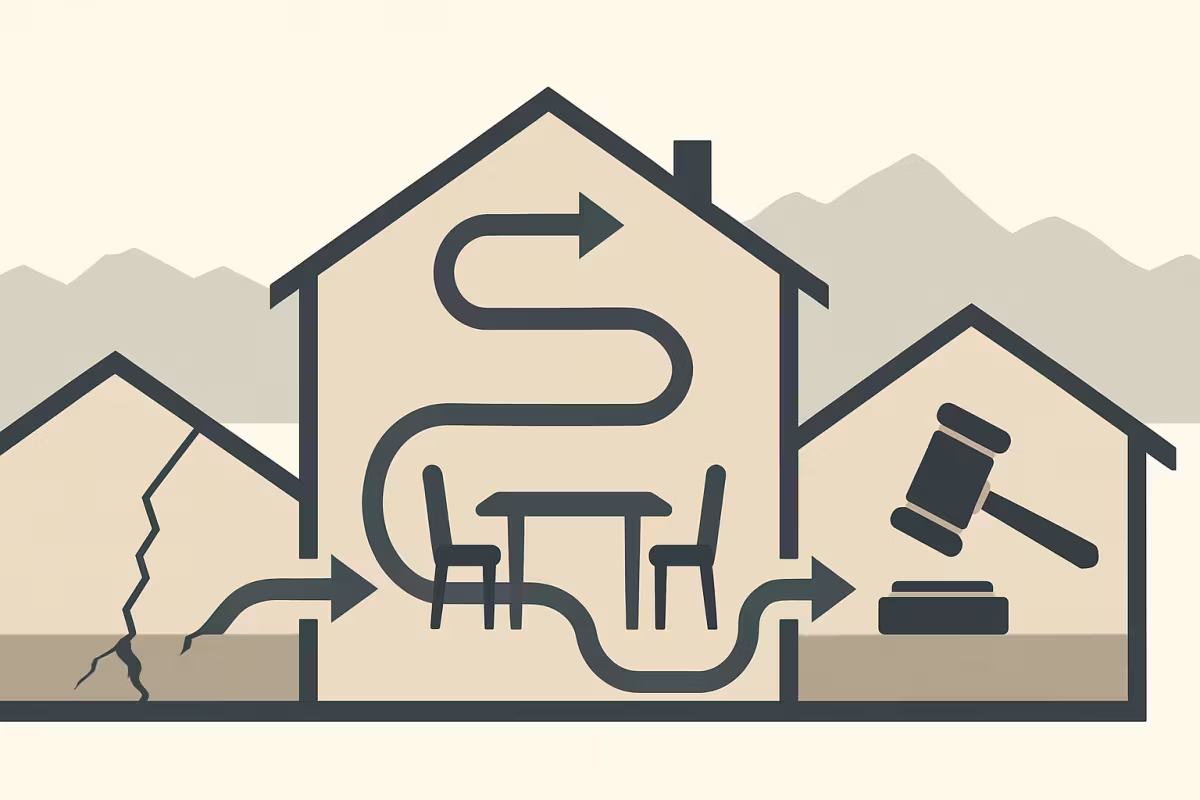
Most disputes between Colorado homeowners and builders travel one of four paths: informal negotiation, mediation, arbitration, or litigation in court. Each has its own rules, costs, timeline, and finality. And in many cases the path is partly chosen for you — by the contract you signed at closing, by the statute that governs the claim, or by the builder's response to your first notice.
This guide walks through the landscape, the Colorado statutes that shape it, and the practical considerations that determine which path is right for your case.
The four paths — and where they overlap
Almost every Colorado construction defect dispute moves through some combination of:
1. Informal negotiation. A demand letter, photos, an engineer's report, and a conversation with the builder. Many smaller defects resolve here, especially when the builder is still in business and wants to preserve its reputation.
2. Mediation. A confidential, non-binding settlement conference led by a neutral mediator. Sometimes voluntary, sometimes required by the contract or ordered by the court.
3. Arbitration. A private adjudication by one or three arbitrators in place of a court trial. Usually required by a clause buried in the purchase or construction contract. Generally binding and final.
4. Litigation. A lawsuit in Colorado district court, with the right to a jury, full discovery, and appeals.
These paths are not mutually exclusive. A typical defect case might start with negotiation, run through a CDARA pre-litigation process, attempt mediation, and only then proceed to either arbitration or court depending on what the contract says. Understanding where you are in this sequence — and what's coming next — is the first step in any sound strategy.
Before any of it: the CDARA Notice of Claim
Colorado is unusual in that, for most defect cases against a builder or developer, a homeowner cannot simply file a lawsuit. The Construction Defect Action Reform Act (CDARA) — C.R.S. § 13-20-803.5 — requires a written Notice of Claim and a chance for the builder to inspect and offer to repair or settle before litigation, arbitration, or, in many cases, mediation can begin.
The statute creates a structured pre-dispute window:
The homeowner serves a written Notice of Claim describing the defects.
The builder has a statutory inspection period — measured in days, not months — to review the alleged defects.
The builder may then make an offer to repair, an offer to settle, or no offer at all.
The homeowner may accept, reject, or counter.
Only after that process plays out does the dispute move into whichever forum the contract or the statute requires. The CDARA framework is detailed in our overview of Colorado construction defect law for homeowners, including the exact notice requirements and what a builder's offer must contain to be valid.
The practical point: skipping CDARA is rarely an option, and getting the notice wrong can cost you procedurally — even when the underlying defect is severe.
Mediation in Colorado construction defect cases
Mediation is the path most homeowners welcome and most are at least somewhat familiar with. A neutral mediator — often a retired judge or experienced construction lawyer — meets with both sides, separately and together, to try to broker a settlement.
Colorado's Dispute Resolution Act, C.R.S. §§ 13-22-301 to 13-22-313, governs the basic ground rules. Two features matter most for homeowners:
Confidentiality. Statements made in mediation generally cannot be used as evidence in later litigation or arbitration. This frees both sides to be candid about what a case is really worth.
Non-binding nature. Nothing the mediator says or recommends is binding. A settlement only happens if both parties sign.
Mediation comes in three flavors in defect cases:
Voluntary, pre-suit. Both sides agree to try mediation before formal proceedings begin. Often the most cost-effective path when both parties want to deal.
Contract-required. Many builder contracts require mediation as a condition precedent to arbitration or suit. Skipping it can give the other side a procedural defense.
Court-ordered. Colorado district courts routinely order mediation before trial. By the time you reach this stage, costs are already significant, but a mediated outcome can still save the expense of trial.
Mediation works best when the dispute is mostly about amount and not liability. When a builder admits the work was defective and only the cost of repair is in question, a good mediator can often close the gap. When the builder denies any defect exists at all, mediation is more of a temperature check than a real settlement opportunity.
Arbitration — the path most often chosen for you
Arbitration is where many Colorado homeowners are surprised to find themselves. Most production-builder purchase contracts and HOA governing documents in Colorado contain a mandatory arbitration clause that funnels disputes out of court and into a private adjudication.
Two statutory frameworks apply:
The Colorado Revised Uniform Arbitration Act, C.R.S. §§ 13-22-201 to 13-22-230, governs most state-law arbitration agreements.
The Federal Arbitration Act, 9 U.S.C. §§ 1 et seq., often applies as well when the contract affects interstate commerce — which most construction contracts do.
Both frameworks generally favor enforcement of arbitration agreements. But "generally favor" is not the same as "always enforce." Arbitration clauses can be challenged on grounds like unconscionability, lack of mutual assent, scope, or specific Colorado public-policy exceptions. Our deep dive on this — Can I Get Out of an Arbitration Clause in Colorado? — walks through the specific arguments that have worked and the ones that almost never do.
For homeowners who do end up in arbitration, the process differs from court in important ways:
One or three arbitrators decide the case instead of a jury.
Discovery is limited — usually fewer depositions and document requests.
Hearings are private and there is no public record of the decision.
Appeals are extremely narrow. An arbitration award can almost never be overturned for legal error.
The trade-off is speed and (sometimes) cost against the broader procedural protections of court. Our Colorado Construction Arbitration Clauses guide covers what these clauses typically say, how arbitrators are selected, what fees look like, and how to prepare for an arbitration hearing.
Litigation — when court is the right path
When no enforceable arbitration clause applies — or when one is successfully challenged — a construction defect dispute proceeds in Colorado district court. Litigation offers things arbitration cannot:
A jury of Colorado residents rather than a single private decision-maker.
Full discovery, including depositions, requests for production, and expert disclosures under Rule 26.
Public proceedings and a public record of the outcome.
A real right of appeal on legal error.
The trade-offs are time and cost. A contested construction defect case in court can run 18 to 36 months from filing to trial. Discovery alone can cost more than many smaller defect claims are worth. Our breakdown of the cost of suing a builder in Colorado walks through filing fees, expert costs, deposition costs, and contingency-fee arrangements.
Court is usually the right path when:
There is no enforceable arbitration clause.
The damages are large enough to justify a multi-year fight.
The case involves issues — like fraud, statutory consumer claims, or punitive damages — that arbitrators tend to handle conservatively.
A jury is likely to view the facts more favorably than a private arbitrator.
Choosing your path — a practical framework
Most of the time, the choice is partly made for you. Here's how to think about what's actually up to you:
Read the contract first. Before you do anything else, find your purchase agreement, construction contract, HOA declaration, and warranty documents. Look for a clause titled "Arbitration," "Dispute Resolution," "Mediation," or "Governing Law." If a mandatory arbitration clause exists, you are likely heading there — unless the clause is challengeable.
Send the CDARA notice correctly. Whatever path the dispute will eventually take, the CDARA process almost always has to happen first. Getting the notice right protects every later option.
Try negotiation and mediation before escalating. A confidential mediation costs a fraction of arbitration or litigation, and a mediated settlement is enforceable. Even if you ultimately end up in arbitration or court, time spent in mediation is rarely wasted.
Treat arbitration challenges as their own case. If you have a colorable argument that the arbitration clause is unenforceable, raise it early and aggressively. Once you participate in arbitration on the merits, you may waive that argument.
Coordinate with your insurer. Construction defect cases often involve multiple insurance policies — yours, the builder's, the design professional's. Notice and timing decisions affect coverage. See our companion Colorado homeowner's guide to insurance and construction defect claims for how the carriers fit into all of this.
Settling vs. seeing it through
Most construction defect cases — in any forum — settle before a final decision. The settlement-versus-trial question is its own strategic decision, and it deserves a deliberate answer rather than a default one. Our discussion of settling out of court versus going to trial walks through the tradeoffs in detail: certainty, speed, recovery net of fees, emotional cost, and the risk of an adverse decision.
The right answer depends on the strength of the evidence, the credibility of the opposing party, the forum, and your own risk tolerance. Good counsel will give you a candid view of all four.
In my practice representing Colorado homeowners, the forum question shapes the case from day one. A homeowner with a strong defect claim and a clean arbitration clause is in a very different posture than a homeowner whose contract has no arbitration provision and whose damages clear the threshold for a jury. We read the contract first, plan the CDARA notice to preserve every option, and decide whether to push toward mediation or prepare for arbitration or trial based on what the documents actually say — not the path the builder prefers. The wrong forum can take a winning case and turn it into a losing one.
If you are a Colorado homeowner facing a construction defect dispute and you are not yet sure which path you are on, we can help you read the contract, plan the CDARA notice, and choose the forum that gives your claim the best chance. Schedule a consultation to talk through your situation.
FAQ
Do I have to mediate before suing my builder in Colorado?
It depends on the contract. Colorado law does not require mediation in every construction defect case, but many builder contracts and HOA documents do. Even when it is not required, CDARA's pre-litigation notice and inspection process is mandatory before most defect lawsuits — and many parties use that window for an informal mediation.
Can I get out of an arbitration clause in my Colorado home purchase contract?
Sometimes. Arbitration clauses can be challenged for unconscionability, lack of mutual assent, fraud in the inducement, scope, or specific Colorado public-policy grounds. Whether a particular clause survives depends on its wording and the circumstances of signing. Our deep dive on getting out of an arbitration clause in Colorado walks through the most common arguments.
Is arbitration cheaper than going to court?
It usually moves faster, but it is not always cheaper. Arbitrator fees can run several hundred dollars per hour and are typically split between the parties, which is a cost a court does not impose. Limited discovery saves money on the front end but can also mean less evidence at the hearing. The cost question is highly fact-specific.
Is an arbitration decision really final?
Almost always, yes. Both the Colorado Revised Uniform Arbitration Act and the Federal Arbitration Act allow a court to vacate an arbitration award only on very narrow grounds — corruption, fraud, evident partiality, the arbitrator exceeding authority, or refusal to hear material evidence. Legal error alone is not enough.
What is the CDARA Notice of Claim and why does it matter?
CDARA — C.R.S. § 13-20-803.5 — requires a Colorado homeowner to send a written Notice of Claim to the builder and allow time for inspection and a settlement or repair offer before suing for most construction defects. Skipping the notice or sending an inadequate one can lead to dismissal or delay. The notice applies before both court litigation and most contractually required arbitration.
Have Questions About Construction Defects?
Our experienced construction defect attorneys are here to help. Schedule a free 15-minute screening call to discuss your situation.