Cladding is your home's first line of defense against Colorado's hail, wind-driven rain, and freeze-thaw cycles. When construction cladding is designed or installed incorrectly, water gets behind the exterior and quietly damages sheathing, framing, and insulation for years before anyone notices. By the time stains or soft spots appear, the repair is often a full recladding — one of the most expensive defect repairs a homeowner can face.
This guide explains the common cladding systems used on Colorado homes, how cladding failures happen, and the legal rights and deadlines that apply when the failure traces back to defective construction.
What Counts as Construction Cladding?
Cladding is any exterior skin system attached to the structure to shed water and protect the building envelope. On Colorado homes the most common systems are:
Stucco — traditional three-coat cement stucco over lath and a weather-resistive barrier.
EIFS (synthetic stucco) — exterior insulation and finish systems, which are especially unforgiving of installation errors because early barrier-type EIFS has no drainage path for trapped water.
Fiber cement siding — durable panels and lap siding, but joint, clearance, and fastening details are frequently botched.
Metal panels — increasingly common on modern builds; leak-prone at penetrations and panel transitions when flashing is improvised.
Brick and stone veneer — masonry veneer needs weep holes and an air gap; when they're blocked or omitted, walls trap moisture.
Vinyl and composite siding — inexpensive and forgiving, but still dependent on proper housewrap and flashing behind it.
How Cladding Failures Cause Hidden Water Damage
Modern wall assemblies assume some water will get past the cladding. The system behind it — the weather-resistive barrier, flashing at windows, doors, and roof-wall intersections, and a drainage path to let water escape — is what actually keeps the structure dry. Most cladding defect cases come down to failures in that concealed system:
Missing or reversed flashing that directs water into the wall instead of out of it
Housewrap that is torn, improperly lapped, or missing behind sections of cladding
No drainage gap or weep screed, so water that gets in has no way out
Sealant used as a substitute for flashing — it works until it fails, then leaks invisibly
Improper clearances at grade, roofs, and decks that let cladding wick water from below
Because the damage is concealed, cladding defects routinely stay hidden for five to ten years. That delay matters legally — Colorado's filing deadlines are measured in years, and they run whether or not you know the defect exists.
Warning Signs Colorado Homeowners Should Watch For
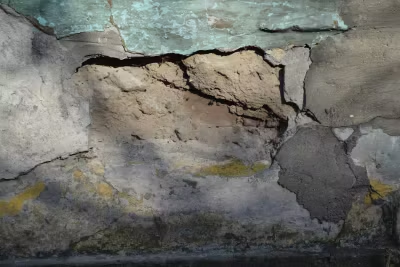
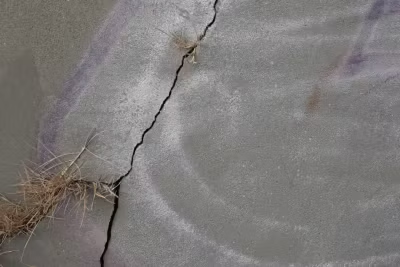
Cracking, bulging, or staining in stucco or EIFS — especially below windows
Soft, spongy, or discolored drywall around window and door openings
Musty odors or mold growth on interior walls
Siding joints that have opened up, cupped, or delaminated
Rust streaks at metal panel fasteners or transitions
Efflorescence (white mineral deposits) on brick or stone veneer
Your Legal Rights: CDARA Claims for Cladding Defects
Cladding defect claims in Colorado are governed by the Construction Defect Action Reform Act (CDARA), C.R.S. §§ 13-20-801 to 13-20-808. CDARA sets out a mandatory pre-lawsuit process: before filing suit, the homeowner serves a written notice of claim describing the defect, and the builder gets an opportunity to inspect and make a settlement or repair offer under C.R.S. § 13-20-803.5. Handled well, that process can produce a funded repair without litigation. Handled poorly, it can waive leverage and burn deadline time.
Deadlines: Statute of Limitations and Repose
Colorado construction defect claims generally must be brought within two years after you discover — or reasonably should have discovered — the physical manifestation of the defect, and in no event more than six years after substantial completion of the home, extendable to eight years when the defect first manifests in the fifth or sixth year (C.R.S. § 13-80-104). Because cladding failures hide inside the wall, homeowners often first see symptoms near the end of that window. If you suspect a cladding problem, the deadline analysis should happen immediately.
What You Can Recover
CDARA damages typically center on the reasonable cost of repairing the defective cladding system and the water damage it caused, and may include related relocation costs and other categories the statute permits. An expert repair scope — not the builder's patch-and-paint estimate — usually drives the real number, because a proper fix often requires removing and replacing the cladding system, not caulking the visible cracks.
What to Do If You Suspect Cladding Defects
Photograph everything — exterior symptoms, interior stains, and any moisture readings, with dates.
Don't let the builder's crew "fix" it first — undocumented repairs can destroy the evidence that proves your claim.
Get an independent building-envelope expert — invasive moisture testing tells you how far the damage extends behind the wall.
Talk to a construction defect lawyer early — the CDARA notice process and the repose clock both reward early action.
Our Colorado construction defect practice page explains how we handle CDARA claims from notice through resolution. If your issue is specifically failing stucco or synthetic stucco, our siding, stucco & EIFS failures page covers those systems in more depth.
Talk to a Colorado Cladding Defect Lawyer
If your home shows signs of cladding failure — cracking stucco, swollen siding, stained drywall below windows — the safest next step is a deadline check and an envelope inspection. Hollington Law Firm represents Colorado homeowners in construction defect claims, and consultations are free.
Have Questions About Construction Defects?
Our experienced construction defect attorneys are here to help. Schedule a free 15-minute screening call to discuss your situation.