This page exists because homeowners in newer Meritage Homes communities sometimes search the internet to figure out whether the problems they are seeing — water stains, stucco cracks, settlement, persistent HVAC issues — are normal for a new house, or whether they point at something the builder is responsible for fixing. I am writing it to give a plainspoken answer to that question, drawn from how Colorado construction-defect law actually works, without taking any position on what has or has not happened in any particular Meritage home.
I represent homeowners in residential construction-defect matters in Colorado. I do not represent Meritage Homes or any other production builder. Nothing in this article is a statement about Meritage's conduct in any specific case. What follows is the framework I would walk through with any homeowner — Meritage or otherwise — who calls about new-construction problems.
The first question is not "is this a defect?"
Homeowners usually open the conversation by describing a symptom — a leak, a crack, a slope in the floor — and asking whether it is a defect. That is not the most useful first question. The first question is what does your paperwork say about it, because production-builder transactions are governed by a stack of documents that defines almost every aspect of what the homeowner can and cannot do when something goes wrong.
The stack usually includes the purchase contract, an express limited warranty (often a third-party administered warranty with one-year, two-year, and ten-year tiers covering different categories of defect), the HOA declaration and design guidelines, and any addenda signed at closing. Before I can give a homeowner a useful answer about a symptom, I need to read those documents. They will typically dictate the notice procedure, the repair-opportunity window, the dispute-resolution forum (sometimes mandatory arbitration), and the categories of damages that are and are not recoverable.
This is not unique to Meritage. It is the architecture of the production-builder business model. The first practical step in any new-construction dispute is to gather the closing binder, the warranty book, and any subsequent warranty correspondence, and to read them — or have a lawyer read them — before doing anything else.
Colorado's Construction Defect Action Reform Act
The next layer is statutory. Colorado's Construction Defect Action Reform Act, at C.R.S. § 13-20-803.5, governs how a residential construction-defect claim against a builder must be initiated.
The mechanics matter. A homeowner cannot simply file a lawsuit on day one. CDARA requires written notice of the alleged defects to the builder, a defined period during which the builder may inspect, and an opportunity to offer a repair, a settlement, or both. The statute requires the homeowner to evaluate that offer in good faith. If the offer is rejected and the case proceeds to litigation, courts pay attention to the reasonableness of both the offer and the rejection.
I describe the procedure this way because I have seen homeowners short-circuit it — sending angry emails, posting public reviews, refusing inspections — and inadvertently weaken their position. The CDARA process is not a formality. It is the structured runway every Colorado defect case has to use, and it is worth running on rails.
The implied warranty of habitability
Colorado recognizes an implied warranty of habitability that runs from a builder-vendor to the first purchaser of a new home. The warranty is not unlimited, but it applies to defects that materially affect the home's fitness for residential use. It can exist alongside an express limited warranty and is not always extinguished by warranty disclaimers, depending on how the documents are written and how the dispute develops.
The practical importance is this: when the express warranty's terms are narrow — and many third-party builder warranties are written narrowly — the implied warranty can sometimes provide a path to recovery that the contractual paperwork would not. Whether it applies to a given home is fact-specific.
Symptoms I would not ignore
Without taking any position on what has occurred in any particular home, the following are the categories of symptom that, in my experience, most often turn out to involve genuine builder responsibility when fully investigated:
Water intrusion through windows, doors, or wall penetrations — particularly intrusion that recurs after a builder repair, which often indicates the underlying flashing or weather-barrier detail is wrong rather than a surface issue.
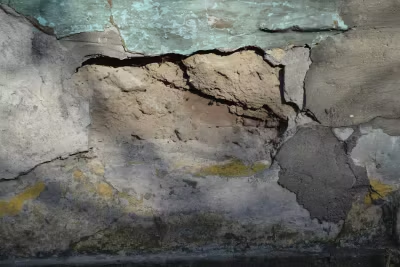
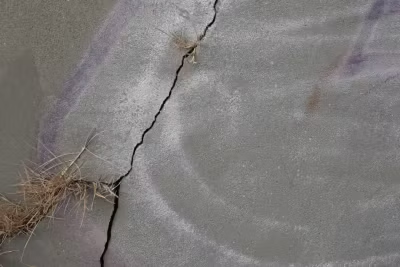
Cracking, separation, or movement in stucco or other exterior cladding systems beyond the cosmetic hairline range — particularly when accompanied by interior moisture readings or drywall cracks at the same elevations.
Differential foundation movement producing sticking doors, cracks across multiple rooms in a consistent direction, or visible separations at the foundation-to-wall connection.
HVAC and air-quality problems that persist after equipment service calls — often a sign that the duct design, return-air path, or building-envelope sealing is the underlying issue rather than the equipment.
Plumbing or drainage problems producing moisture in walls or below slabs.
Any of these, if it turns out on inspection to be tied to a construction defect rather than a maintenance or aging issue, can fall within the framework above. The "if" is doing a lot of work — that is what an inspection is for.
The repair offer
When a homeowner gives notice and the builder responds with a repair offer, the question I am usually asked is whether to accept it. The honest answer is that it depends on three things: what is actually wrong, what the proposed repair actually does about it, and what rights the homeowner is being asked to give up in exchange.
The third element is the one that tends to surprise people. Some repair offers come with broad releases — the homeowner accepts the repair, and in exchange gives up any future claim related to the underlying condition, even if the repair turns out to have been inadequate. Whether a release is enforceable in a given situation depends on the document and the circumstances, but the safer practice is to have a release read by someone before it is signed.
A repair offer can be a perfectly good outcome. Many are. But "the builder is offering to fix it" is a starting point for analysis, not the end of one.
Time matters
Colorado's construction-defect statute of limitations is at C.R.S. § 13-80-104. The general rule is that an action must be brought within two years after the claim accrues — typically the date the defect, or its physical manifestation, was discovered or should have been discovered through reasonable diligence. There is also a statute of repose with an outside limit.
The intersection of CDARA's notice procedure and the statute of limitations is something I would not try to navigate without specific advice. Sending a notice too late, or sending it correctly but failing to file suit within the remaining window, can extinguish a viable claim. This is the single most common way I see otherwise meritorious homeowner cases lost.
What I tell homeowners on a first call
If you are reading this page because you bought a Meritage home and have been seeing symptoms that worry you, three steps are useful before any conversation about whether you have a "case":
Gather the paperwork. Purchase contract, every page of the warranty (front and back), any addenda, any correspondence with the builder, photographs of every symptom with dates.
Do not sign anything new from the builder until someone has read it. That includes releases, repair authorizations, and addenda to existing warranty agreements.
Pay attention to dates. When did you first notice each issue? When did you first report it? Those dates are evidence and they affect the limitations analysis.
A short consultation can usually take those three inputs and produce a useful answer: whether what you are seeing looks like a maintenance issue, a warranty issue, or a genuine construction-defect issue; whether it is worth opening a CDARA notice; and what the realistic path forward looks like. The consultation is free, and the analysis is yours regardless of whether we work together.
Have Questions About Construction Defects?
Our experienced construction defect attorneys are here to help. Schedule a free 15-minute screening call to discuss your situation.