
Fort Collins Construction Defect Lawyer | Hollington Law
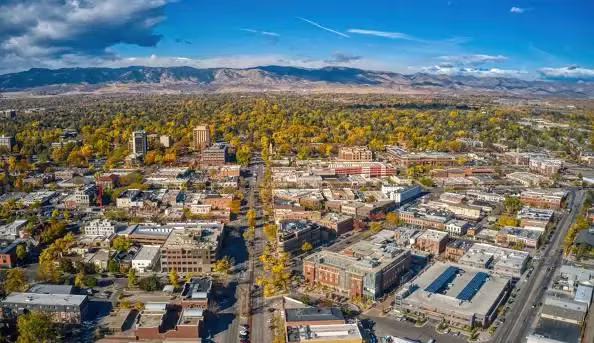
Fort Collins and the surrounding Larimer County housing market have grown faster than almost any other part of Colorado over the last decade. Tract construction in Timnath, Wellington, and Windsor, foothills builds near Horsetooth and Masonville, downtown and Old Town remodels, and CSU-driven rental conversions have all expanded the inventory of homes — and produced a steady stream of construction defect cases. When something goes wrong in a Fort Collins home, homeowners need a construction defect lawyer who understands both the local geology and the procedural rules in the 8th Judicial District.
Hollington Law Firm represents Fort Collins-area homeowners in construction defect matters throughout Larimer, Weld, and northern Boulder Counties. This page explains what makes Fort Collins defect cases distinct and how the process works.
Why Construction Defects in Fort Collins Are Different
Three things separate Fort Collins defect work from the markets to the south: the geology, the growth rate, and the river systems.
Pierre Shale and Expansive Soils
A substantial part of Fort Collins, including much of the southern and eastern parts of the city and large portions of Larimer County's growth corridor, sits on the Pierre Shale formation. Pierre shale is a swelling clay-shale that absorbs water, expands aggressively, and shrinks back as it dries — the same mechanism that makes Denver's bentonite soils so destructive, on a similarly serious scale. Homes built without the right foundation system for these soils — drilled piers, structural floors, isolated voids, and engineered drainage — routinely move within five to fifteen years.
Symptoms in Fort Collins are familiar:
Diagonal stair-step cracking in drywall and masonry
Doors and windows that stick or fail to latch as the structure shifts
Basement wall cracking — particularly stepped or horizontal cracks
Floor slopes, gaps along baseboards, and patio separation from the house
Drywall pops and nail pops along framing lines
The Colorado Geological Survey has mapped the most problematic areas. Builders working in those areas are required to design and construct to those soil conditions. When they don't, the failure is a foreseeable construction defect, not a surprise.
Rapid Tract Construction
The growth corridor north and east of Fort Collins — through Timnath, Wellington, Severance, and Windsor — has been one of Colorado's fastest-growing residential markets. National and regional production builders have turned out tens of thousands of homes in this corridor over the last decade. The defect patterns in volume construction tend to repeat across an entire subdivision:
Identical flashing details installed wrong on every house in a phase
Foundation work performed in winter conditions without proper temperature control
Drainage and grading completed before adjacent lots are built out, then disturbed
Mechanical penetrations through fire-rated assemblies
Framing connections missed or substituted because the entire crew was rushed
If one home in a development has a specific defect, neighboring homes very often have the same one. That pattern matters strategically when planning a claim.
Floodplain and River Construction
Fort Collins straddles the Cache la Poudre River, and large parts of the city and surrounding Larimer County housing stock sit in or near mapped floodplains. The catastrophic September 2013 flood reshaped how the city, the county, and the state regulate floodplain construction, but a meaningful portion of the existing housing stock predates those changes. Defects we see in floodplain-adjacent construction include:
Inadequate foundation waterproofing and perimeter drainage
Crawl-space and basement moisture problems
Sump systems undersized for high groundwater
Mechanical equipment installed below the base flood elevation
Improper venting in flood-prone construction
The post-2013 rebuild work in the Big Thompson Canyon and along the Poudre also produced its own catalog of defect issues as homes were rebuilt under unusual conditions.
Common Construction Defects We See in Fort Collins Homes
Patterns across the Fort Collins caseload:
Structural and geotechnical
Foundation movement on Pierre shale and expansive soils
Inadequate caisson depth, missing structural floors, or omitted void spaces
Slab heave and slab-on-grade failures in basements
Drainage failures channeling water toward the foundation
Retaining-wall failures on graded lots
Water and envelope
Stucco and siding failures with hidden moisture damage
Window and door flashing defects
Roof flashing failures at chimneys, skylights, and roof-to-wall transitions
Crawl-space and basement moisture intrusion
Inadequate vapor and air control in higher-performance assemblies
Workmanship in volume new construction
Repetitive flashing or framing errors across a subdivision
Missing structural connections at critical load paths
HVAC undersized or improperly ducted
Plumbing routed through unconditioned spaces and freezing
Electrical and mechanical work performed under inspection pressure
Remodels and Old Town work
Structural alterations performed without permits or engineering
Removed load-bearing walls without proper beam substitution
Foundation underpinning that introduces new movement
Modern systems retrofitted into historic-era homes without addressing existing assemblies
Your Legal Rights as a Fort Collins Homeowner
Colorado's Construction Defect Action Reform Act, C.R.S. §§ 13-20-801 through 13-20-808 governs construction defect claims throughout the state, including Fort Collins. CDARA imposes a pre-litigation sequence that must be followed before suit.
The Notice of Claim Process
Before filing a construction defect lawsuit in Larimer County, a homeowner must serve a Notice of Claim on the builder, contractor, or design professional under C.R.S. § 13-20-803.5. The notice triggers:
A 30-day inspection period for the builder
A 60-day offer period in which the builder may offer repair, payment, or both
The homeowner's election to accept, reject, or treat the offer as inadequate
The notice must describe each alleged defect with reasonable specificity. Suing without a proper notice can result in dismissal and the loss of fee-shifting protections.
Statutes of Limitations and Repose
Under C.R.S. § 13-80-104, Colorado imposes:
A two-year statute of limitations running from discovery of the defect, and
A six-year statute of repose from substantial completion, extended to eight years if the defect manifests in the fifth or sixth year
In Fort Collins growth-corridor neighborhoods, where many homes are now passing the five-to-eight-year mark, the repose statute is often the controlling deadline. Symptoms that surface in years four and five must be acted on quickly, because the window for filing may close within months.
HOA and Common-Interest Community Claims
The Fort Collins corridor has a substantial inventory of HOA-governed townhomes and small-lot single-family communities. HOA-level defect actions involving common elements are subject to additional procedural requirements — including owner-vote and disclosure provisions added by HB 17-1279 — that do not apply to individual single-family claims. Knowing which track applies, and how the two interact, is an early issue in any HOA-adjacent case.
Where Fort Collins Cases Are Filed
Larimer County construction defect cases are filed in the District Court for the 8th Judicial District at the Larimer County Justice Center in Fort Collins. Cases involving property in Weld County (including Windsor's Weld County addresses, parts of Severance, and Greeley) are filed in the 19th Judicial District in Greeley.
A property's actual county is determined by the legal description, not the postal address. A "Windsor, CO" address may be in Weld County or Larimer County depending on the lot, and getting the venue right matters from day one.
Arbitration clauses are common in volume-builder contracts in the Fort Collins corridor. The enforceability and scope of those clauses is one of the first issues a Fort Collins construction defect lawyer evaluates.
What to Do If You Suspect a Construction Defect in Your Fort Collins Home
Document everything with dates. Photos of cracks, water staining, sloping, separations, and any related symptoms. Save service requests, builder communications, warranty submittals.
Do not perform invasive repairs yet. Drywall, stucco, foundation, or roofing repairs before a defect inspection can destroy the evidence needed to prove cause.
Pull the records. Closing documents, builder warranty, geotechnical reports, original plans, Fort Collins or Larimer County building permits and inspection cards, HOA disclosures, prior real-estate inspection reports.
Get a defect-focused inspection. A real-estate inspection is not designed to identify construction defects. We coordinate with structural engineers, geotechnical engineers, building-envelope consultants, and other specialists matched to the symptoms.
Consult a Colorado construction defect attorney. CDARA deadlines, the statute of repose, and any contract-based notice or arbitration triggers may all be running in parallel. The earlier counsel is involved, the more options stay open.
Why Choose Hollington Law Firm for a Fort Collins Construction Defect Case
W. Neal Hollington has represented Colorado homeowners in construction defect matters for more than a decade. Our Northern Colorado work includes:
Pierre shale and expansive-soils foundation cases throughout Larimer and Weld Counties
Volume-builder defect cases in Timnath, Wellington, Windsor, and Severance
Old Town and historic-home remodel disputes
Floodplain and post-flood rebuild claims
HOA-adjacent townhome and condominium defect issues
Mechanic's lien and contractor-payment disputes (Colorado mechanic's lien guide for homeowners)
We work on a free initial consultation basis and explain realistic outcomes, costs, and procedural hurdles before any commitment.
Talk to a Fort Collins Construction Defect Lawyer
If you suspect a defect in your Fort Collins home, do not wait. Pierre shale and expansive-soils failures rarely get cheaper to fix once they are visible, and Colorado's repose statute is unforgiving. Schedule a free consultation and we'll evaluate the facts, the timing, and the realistic options.
---
This page is for general information only. It is not legal advice, and reading it does not create an attorney-client relationship. Every construction defect case turns on the specific facts, contract terms, geology, and timing involved. Speak with counsel about your situation before taking action.
Last reviewed by W. Neal Hollington on May 13, 2026.
Other Areas We Serve
View All Areas





Have Questions About Your Case?
Schedule a free 15-minute screening call to discuss your construction defect or property damage claim with our experienced attorneys.