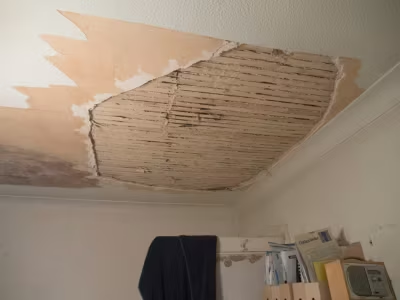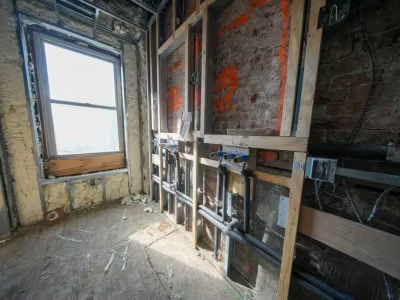
If you own a home in Colorado and you've noticed signs of construction problems — cracking foundations, water intrusion, sloping floors, failing exterior systems — you have a finite window to act. Colorado law imposes some of the strictest deadlines in the country on construction defect claims, and missing one of them can end an otherwise strong case before it begins. This guide explains every deadline that applies to a Colorado construction defect claim, in one place, in the order they tend to matter to a homeowner.
The four deadlines that drive the timeline are the statute of limitations, the statute of repose, the builder's warranty period, and the CDARA Notice of Claim sequence. They run in parallel, not in series, and the operative one in any given case depends on the facts.
The Two Statutes Every Colorado Homeowner Should Know
Colorado treats construction defect claims under a hybrid framework set out at C.R.S. § 13-80-104. Two separate clocks run at the same time.
Statute of Limitations: Two Years from Discovery
The statute of limitations is the more familiar of the two. It says that a construction defect claim must be filed in court within two years after the cause of action accrues — meaning the date the homeowner discovered, or with reasonable diligence should have discovered, the physical manifestation of the defect.
The two-year limitations period is the deadline most likely to be missed accidentally. Three points matter:
The clock starts at the first discovery of the physical manifestation — not when the homeowner figures out who is at fault or what the legal theory is. Cracks in drywall, water staining, foundation cracks, doors that won't close — once the symptom appears and a reasonable homeowner would have investigated, the clock is running.
"Reasonable diligence" is judged objectively. A homeowner who saw the symptom, attributed it to "settling," and did nothing for three years cannot reset the clock by hiring an expert on year four. Courts look at what a reasonable owner would have done at the moment the symptom first appeared.
Each independent defect can have its own clock. A foundation crack in 2023 and a stucco failure discovered in 2026 may have separate accrual dates and separate two-year windows.
Statute of Repose: Six Years (or Eight) from Substantial Completion
Layered on top of the limitations period is the statute of repose, the harder deadline. Unlike the limitations period, the repose period does not run from discovery — it runs from the date the improvement was substantially completed. The repose period gives builders a definite, outside cutoff after which they can no longer be sued for construction defects, regardless of when the defect was discovered.
Under C.R.S. § 13-80-104(1)(b), the basic repose period is six years from substantial completion. If the defect first manifests during the fifth or sixth year, the homeowner gets an additional two years to file suit — for a maximum effective deadline of eight years from substantial completion.
The interaction between the two statutes is what trips homeowners up. Examples:
Year 3 discovery, year 5 lawsuit filed. Limitations clock: 2 years from year 3 = year 5. Repose clock: year 6. Both met. Suit is timely.
Year 4 discovery, year 7 lawsuit filed. Limitations clock: 2 years from year 4 = year 6. Suit is out of time even though repose has not run.
Year 5 discovery, year 7 lawsuit filed. Limitations clock: 2 years from year 5 = year 7. Discovery during year 5 also triggers the two-year tolling extension, pushing repose out to year 8. Suit is timely.
Year 9 discovery, lawsuit filed promptly. Repose has already run. Suit is barred regardless of how recent the discovery was.
The repose statute is the most unforgiving rule in Colorado construction defect law. It does not bend for hidden defects, contractor concealment, or homeowners who were not the original buyers. There are limited exceptions for fraud and willful misconduct, but they are narrow and difficult to prove.
Determining "Substantial Completion"
Because the repose clock starts at substantial completion, that date is often the most important fact in the whole case. Colorado courts have defined "substantial completion" as the point at which the improvement is sufficiently complete in accordance with the contract that the owner can use the improvement for its intended purpose. Practical evidence courts look at:
The date of the certificate of occupancy issued by the building department
The closing date of the original sale to the first owner
The date of the builder's final punch-list sign-off
The completion of the last major construction trade on the project
Final inspection records and final payments to the builder
Different evidence can point to different dates, sometimes by months. In a borderline case, that gap may decide whether suit is timely.
For HOA-governed condominium and townhome projects, substantial completion can also vary by building within a multi-phase project. Common-element claims tied to building A may run on a different clock than common-element claims tied to building B.
Builder's Limited Warranty: A Separate, Shorter Clock
Most builder contracts in Colorado include a limited one-year workmanship warranty, sometimes paired with longer warranties for specific systems (two years for mechanical and electrical, ten years for major structural). The warranty period is a contract right, not a statutory one. It runs separately from the limitations and repose statutes.
Two implications for homeowners:
Calling the builder under warranty does not toll the statute of limitations. A homeowner who reports a defect to the builder at month 11, then waits two years for warranty repairs that never come, may have missed the limitations period in the meantime.
Warranty work itself can create new defects. A "warranty repair" performed badly can give rise to its own claim with its own accrual date. Documenting warranty work matters.
Many Colorado builder contracts also include arbitration clauses, attorney-fee provisions, and damage limitations. These are contract terms separate from the statutory deadlines and must be analyzed before any notice or filing.
The CDARA Notice of Claim Process
Before filing a construction defect lawsuit in Colorado, a homeowner must serve a Notice of Claim on the builder, contractor, or design professional under the Construction Defect Action Reform Act, C.R.S. § 13-20-803.5. The Notice of Claim sequence is procedural, not jurisdictional — but skipping it can result in dismissal of the lawsuit and the loss of statutory fee-shifting protections.
The sequence operates in two phases:
30-day inspection period. Once the Notice is served, the builder has 30 days to inspect the property. The homeowner must reasonably cooperate.
60-day offer period. Following the inspection, the builder has 60 days to offer to repair the defect, pay money, or both. The homeowner then accepts, rejects, or treats the offer as inadequate.
The Notice must describe the alleged defects with reasonable specificity. A generic notice that does not give the builder a fair opportunity to investigate can be rejected as defective. For complex cases — especially expansive-soils foundation cases or whole-envelope failures — the Notice typically requires expert support before it is served.
The Notice of Claim process tolls the statute of limitations under C.R.S. § 13-80-104(1)(b)(II), but only for the actual statutory periods (30 + 60 days). It does not toll the statute of repose. Builders sometimes drag out the offer-and-counter-offer process precisely to push the homeowner past repose.
HOA and Common-Interest Community Deadlines
For townhome and condominium HOAs, Colorado law layers additional procedural requirements on top of the statutory deadlines. Under HB 17-1279 and related amendments, an HOA board may not pursue a construction defect lawsuit involving common elements without:
A formal disclosure to all unit owners
An owner vote authorizing the litigation
Compliance with notice and meeting requirements
The HOA-level claims process moves more slowly than an individual single-family claim. The repose statute does not pause to accommodate the slower process. HOA boards that begin the defect-claim process late often run out of repose time before they can complete the owner-vote procedures.
Tolling, Tolling Agreements, and Special Cases
Several mechanisms can extend the deadlines in narrow circumstances:
Tolling agreements. Builders sometimes sign tolling agreements with HOAs or individual homeowners — written contracts that pause the limitations clock to allow negotiation without a lawsuit on file. Tolling agreements rarely toll the statute of repose.
Fraudulent concealment. A homeowner who can prove the builder fraudulently concealed the defect may, in narrow cases, extend the limitations period. The repose statute has limited carve-outs for willful or wanton conduct.
CCPA claims. Colorado Consumer Protection Act claims tied to misrepresentation by the builder run on the CCPA's own deadlines, which can be shorter or longer than the construction defect deadlines depending on the theory.
Bankruptcy. A builder's bankruptcy filing can toll some deadlines while the automatic stay is in place.
None of these is a reliable safety net. They are exceptions, not strategies.
Damages Once the Claim Is Timely
Colorado caps and shapes the damages recoverable in a construction defect case under C.R.S. § 13-20-806. Available damages may include:
The reasonable cost to repair the defect
Investigation, expert, and engineering costs reasonably incurred
Diminution in market value where the defect is not fully repairable
Loss-of-use and temporary relocation costs during remediation
Statutory remedies under the Colorado Consumer Protection Act in misrepresentation cases
Attorneys' fees in specified CDARA and CCPA contexts
CDARA also limits non-economic damages and certain treble-damage theories. The damages analysis interacts with the contract terms — particularly damage-limitation clauses in homebuilder agreements — and is one of the first issues a Colorado construction defect lawyer evaluates after the timeliness question.
What to Do If You Think a Deadline Might Be Running
The order of operations is the same regardless of which deadline is approaching.
Pin down substantial completion. Closing date, certificate of occupancy, final inspection, and final payment records all point to it. If you cannot establish substantial completion within a year or two, the repose date is uncertain — and uncertainty favors filing sooner.
Document the first appearance of every symptom. Photos with dates, service requests, warranty submittals, emails to the builder. Each symptom can have its own limitations clock.
Do not perform invasive repairs yet. Patching, sealing, or rebuilding before a defect inspection can destroy evidence of cause.
Identify the parties. Builders, subcontractors, design professionals, manufacturers — and which of them are still solvent and reachable. Statutes of repose protect each defendant independently.
Get a defect-focused inspection. Real-estate inspections do not identify construction defects. A construction defect lawyer can coordinate with the right combination of structural, geotechnical, and building-envelope experts.
Consult a Colorado construction defect attorney early. CDARA notice, contract notice triggers, arbitration provisions, and the limitations and repose statutes can all be running at the same time. Early counsel preserves the most options.
How a Construction Defect Lawyer Evaluates Timeliness
In any Colorado construction defect intake, the timeliness analysis is the first thing a lawyer does — before discussing damages, theories of liability, or strategy. The questions are simple and concrete:
What is the date of substantial completion?
What is the earliest date any symptom appeared, and is there documentary support for that date?
Has the homeowner served a CDARA Notice of Claim, and if so, when?
Are there warranty or arbitration provisions that affect the path to court?
Are there HOA-level common-element claims with their own owner-vote requirements?
Is there a tolling agreement on file with the builder?
If the answers leave a viable window, the lawyer moves on to the merits of the claim. If the answers don't — if repose has already run, or if the limitations period was missed years ago — the lawyer says so directly and saves the homeowner the cost of pursuing a barred case.
Talk to a Colorado Construction Defect Lawyer
Colorado's construction defect deadlines are unforgiving, but they are also predictable. The homeowners who lose otherwise good cases are almost always the ones who waited — through warranty repairs, through "settling" denials, through hoping the problem would resolve itself. The cost of an early conversation with a Colorado construction defect lawyer is far lower than the cost of waiting until repose has already run.
Hollington Law Firm evaluates timeliness for Colorado construction defect cases statewide on a free initial consultation basis. We can usually tell you within a short conversation whether your claim is in time, and what your next step looks like. Learn more about our construction defect lawyer practice.
If you also have a contractor-payment or mechanic's lien issue, those deadlines run separately and need to be analyzed alongside the construction defect timeline.
---
This article is for general information only. It is not legal advice, and reading it does not create an attorney-client relationship. Every construction defect case turns on the specific facts, contract terms, and timing involved. Speak with counsel about your situation before taking action.
Last reviewed by W. Neal Hollington on May 13, 2026.
Have Questions About Construction Defects?
Our experienced construction defect attorneys are here to help. Schedule a free 15-minute screening call to discuss your situation.